We got plenty of questioning looks when we said we were going to
tour Southern Alberta and Saskatchewan for our holidays this year. I had
Grasslands National Park as my main destination but almost missed it as there
were so many distractions to see along the way. As it was, we only got to see
the west block of the park so will have to go back for a second look.
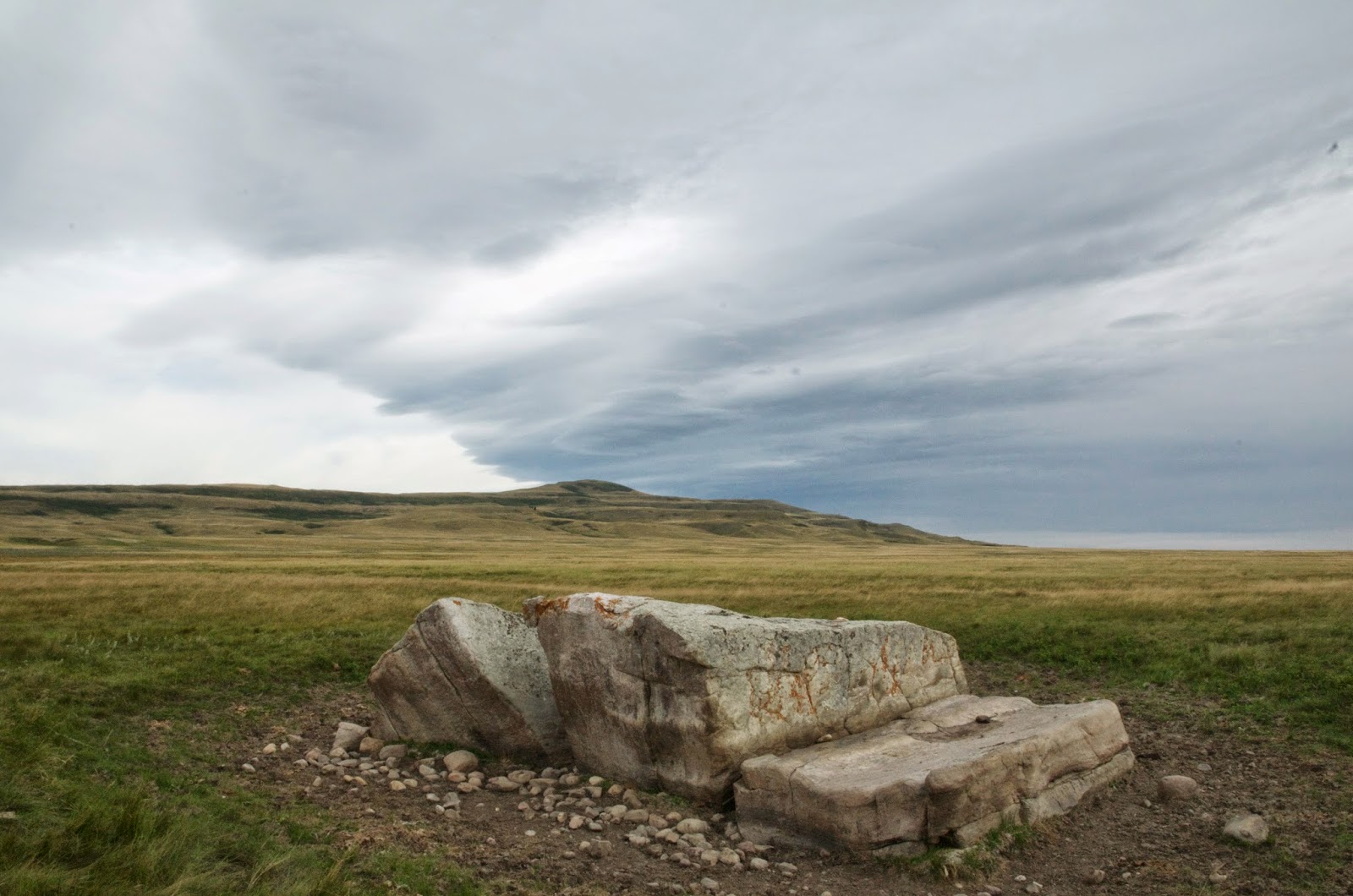
Distances are vast in these provinces. The prairie stretches on and on and on; always another rise, coulee, more grass and sky. I have to think of our ancestor settlers who came by oxen drawn Red River Carts. These rough and durable boxes on wooden wheels move at about 2 miles per hour on flat ground. Every coulee, hill, creek or river added additional time to getting anywhere. A man on a horse might travel 4 to 5 miles per hour so what we may travel in our car in one hour would take up to 3 days for them to cover. I look over the landscape and see cart jarring rocks and gopher holes to fall into and unreachable horizons stretching on into a distant bluish haze. Progress would have been marked by the passing of a distant rock or the ascent of the next ridge line. This land seems flat but it is not. It undulates and flows for miles, through drainage coulees and draws, small knolls and natural dips and swales. On any rise you overlook long miles over seemingly deserted land.
This prairie is treeless except for shelter belts that were planted by settlers trying to minimize the wind while collecting drifting snow. There are places where there is not a single tree for as far as you can see. I saw one tree that chose the road side ditch to live and it had been preserved. It was the only woody specimen in this area. It looked very bedraggled by few branches sticking out the east facing bole, but stood proudly, doing its part to provide shelter and a roost for hunting hawks. The seed for this tree must have been dropped off on a flyover dropping from a passing bird.
It is agricultural land, for the most part, these days. Some of this land is now cropped and the land that is too marginal or rocky is pastured. There are many sections of hard grass land that feed very healthy herds of cattle. It requires many more acres of ground to feed a cow here than it does on tame grass pasture but this hard, prairie grass is very nutritious.
The cropped land, this year anyway, has had too much rain throughout southern Saskatchewan so many crops are later than usual. Farmers are going to be under tremendous stress before their grains are all stored safely in the bins.
As we drive, I wonder at the stories that the walls of the abandoned
farmhouses and homesteads could tell. There are many beautiful looking old
homes that are no longer used. Many of them are situated on a slight rise with
tremendous views of surrounding landscape. The beauty of the land grew upon
these settlers as it does on me.
Ever-changing skies, spectacular thunderstorms, big, brightly lit night
skies, sunrises and sunsets along with the play of mid day light across the
visible miles draw us in. Did the optimistic builders sell out to larger
farmers, go broke or frustrated and give up or pass away with no interested
heirs? We are losing these stories as the older generations pass away.
I remember running some of this equipment and trucks that the prairie is slowly reclaiming. Wind, moisture, insects, time and neglect assist the prairie's reclamation efforts. I have to think back to when the farmer drove his brand new, to him, 1949 Chevrolet truck into the yard and filled it with grain harvested from the once mighty Massey Harris 92 combine.
Old churches and cemeteries mark the last plots of ground the pioneers will use. They are well maintained by future inhabitants and some of the stones give us some ideas about where they came from as well as their passions. We also noted school district signs marking where schools once stood. Many were one room schools with a pair of toilets set back in the yard and some even had hitching rails for the horses that carried students to their studies.
Once thriving, vital small towns show signs of dying a slow death due to neglect. Potholed and cracked streets lead to boarded up stores and businesses and abandoned homes. Hidden infrastructure like water and sewer lines are crumbling and it will not be long before many towns cannot afford to maintain water or sewer treatment plants. There are a few optimistic “for sale” realty signs staked into neglected lawns or nailed onto tumbleweed-lined wooden fences. Prices are reasonable if you could find a way of making a living here. Many of the town schools have been closed or converted to other uses as student numbers dropped and continuous centralization occurs. Even once proud ball diamonds and backstops are no longer used and suffering similar decay due to abandonment. Former vital prairie sentinels, the grain elevators are being torn down and replaced by new power producing wind cyclone sentinels. The prairie is slowly reclaiming the land in its slow and patient manner. "The meek shall inherit the earth," is proven here. Like the wind that never ceases, the grass never stops growing or spreading to cover and protect the precious land.
Even amongst obvious neglect there is pride, promise and optimism for the future. Large farms and livestock operations have the most modern equipment and comfort available. Parts of the prairie are dotted by oil and gas wells, pipelines and pump jacks with storage tanks. Other farmers have diversified into raising new crops such as lentils, peas and bison. This always has been a land of change and will continue to evolve and thrive with sturdy people.
We did finally make it to the Grasslands National Park Visitor center in Val Marie, Sask. After getting some hints, directions and advice we headed down the road and across the Texas gates. As the name implies, this is grassland. It is a small fraction of a threatened, unique landscape now protected and preserved for future generations. This park will continue to grow as surrounding land can be purchased from existing landowners.
In 2005 about 75 Plains Bison were introduced to Grasslands Park
from Elk Island National Park. In the spring of 2006 they were set free to roam
where buffalo are supposed to roam. In 2013, the herds numbered about 350
members and are doing very well. The bison we saw look very healthy and
content. They suit this landscape as expected. Bison are good for the land and
the grass. With a combination of grazing, wallows, prairie dogs and fire the
park will slowly revert to natural prairie grasslands.
We drove into a Black-tailed Prairie Dog (Cynomys ludovicianus) colony too. These critters are known to be keystone species to prairie grasslands. These prairie engineers provide homes to endangered and threatened species such as the burrowing owl, prairie rattlesnakes, Horned lizards, Swift fox and most endangered of all, the Black-footed Ferret. The burrows they create mix soil strata, fertilize with droppings and carcasses, allow rainfall water in and grass seeds to germinate. They provide food for hawks and owls, ferrets as well as coyotes and foxes. This chunky little ground squirrel is very alert and entertaining to watch. They are much larger than the pocket gopher that is also native to this region. One of the highlights, for me, was to see a wild Burrowing Owl. These shy little owls are listed on the endangered list due to habitat loss and chemical spray residues. Today, we spotted 3 of them scattered throughout this prairie dog colony.
There are many short trails to information placards scattered along the road through the park. These worthwhile informative signs describe many aspects of the terrain, the settlers and wildlife that you may be looking at.
We wandered away from the car to have a look into the Frenchman River valley. Here, we spotted the first Bison in the park. Two solitary bulls were grazing calmly in the river valley, well away from a larger herd of cows and calves. They suit this area very well. These two bulls were in premium condition with prime coats ready for the coming winter. I had to get closer so I wandered down the hill behind a knoll, well hidden and downwind from the grazers. Bison are not supposed to have great eyesight, but they spotted me as soon as I stuck my head above the hill top. We were about 150 yards away so they did not panic and run away. I enjoyed the time I spent with these two icons of the grasslands.
As I gazed around with my binoculars, I spotted three, cud-chewing, mule deer bucks lying on a windswept side hill about 300 yards away. They were a bit downwind but I could stalk them from behind another knoll, which I did. I emerged through some sage wavering in the wind to a point that I could watch them. One of them caught my wind and stood up which caused the others to also stand up and mill about. They could smell me but couldn’t see me so were confused. Five or ten minutes passed before the spooky one lay back down. I backed off behind my hill and wandered back toward my distant car. Even if the land looks lifeless and flat and barren, I learned long ago that you just have to sit down for a few minutes and watch. It never ceases to amaze me what emerges from hidden hidey-holes.
As the day was progressing we thought we would check out a local B&B called the Rosefield Church Guest House. It cost 125.00 per day so we booked one night then headed to Val Marie, about ½ hour away, for groceries and supper. This guesthouse no longer serves breakfast unless by special order. Many of their guests are artists or photographers who typically leave before sunrise, so they miss breakfast. They do provide a fully stocked kitchen so you could provide yourself with any meals you like. We got back in time to watch the sunset in Grassland Park. The light is beautiful here at this hour, not to be missed by any photographer or sky watchers. Grasslands is a dark sky preserve so we got out and watched the Milky Way as best we could with the waxing full moon. Timing and luck must be right for everything. Distant coyote chatter brought to life an otherwise quiet night as I wandered down the gravel road. I am not a very nocturnal creature but do enjoy the night time in any wilderness setting. It is certainly a special time here under the prairie sky.
We were up before daylight and on the road in search of a great
viewpoint from which to watch the sunrise. Fog rose stealthily from the
meandering river and dew sparkled as first chilly, golden rays shone onto
hanging spider webs and nestled dragonflies. Once again, walk slowly and see
what you are looking at proved to be valuable advice this morning. Beauty is in
the details of the grasses at our dew soaked shoes and pant legs, not just in
the glorious, wide open landscape.
Distances are vast in these provinces. The prairie stretches on and on and on; always another rise, coulee, more grass and sky. I have to think of our ancestor settlers who came by oxen drawn Red River Carts. These rough and durable boxes on wooden wheels move at about 2 miles per hour on flat ground. Every coulee, hill, creek or river added additional time to getting anywhere. A man on a horse might travel 4 to 5 miles per hour so what we may travel in our car in one hour would take up to 3 days for them to cover. I look over the landscape and see cart jarring rocks and gopher holes to fall into and unreachable horizons stretching on into a distant bluish haze. Progress would have been marked by the passing of a distant rock or the ascent of the next ridge line. This land seems flat but it is not. It undulates and flows for miles, through drainage coulees and draws, small knolls and natural dips and swales. On any rise you overlook long miles over seemingly deserted land.
This prairie is treeless except for shelter belts that were planted by settlers trying to minimize the wind while collecting drifting snow. There are places where there is not a single tree for as far as you can see. I saw one tree that chose the road side ditch to live and it had been preserved. It was the only woody specimen in this area. It looked very bedraggled by few branches sticking out the east facing bole, but stood proudly, doing its part to provide shelter and a roost for hunting hawks. The seed for this tree must have been dropped off on a flyover dropping from a passing bird.
It is agricultural land, for the most part, these days. Some of this land is now cropped and the land that is too marginal or rocky is pastured. There are many sections of hard grass land that feed very healthy herds of cattle. It requires many more acres of ground to feed a cow here than it does on tame grass pasture but this hard, prairie grass is very nutritious.
The cropped land, this year anyway, has had too much rain throughout southern Saskatchewan so many crops are later than usual. Farmers are going to be under tremendous stress before their grains are all stored safely in the bins.
 |
| Abandoned Prairie Homestead |
I remember running some of this equipment and trucks that the prairie is slowly reclaiming. Wind, moisture, insects, time and neglect assist the prairie's reclamation efforts. I have to think back to when the farmer drove his brand new, to him, 1949 Chevrolet truck into the yard and filled it with grain harvested from the once mighty Massey Harris 92 combine.
 |
| Chevy 2 Ton Grain Truck Massey 92 in Background |
Old churches and cemeteries mark the last plots of ground the pioneers will use. They are well maintained by future inhabitants and some of the stones give us some ideas about where they came from as well as their passions. We also noted school district signs marking where schools once stood. Many were one room schools with a pair of toilets set back in the yard and some even had hitching rails for the horses that carried students to their studies.
Once thriving, vital small towns show signs of dying a slow death due to neglect. Potholed and cracked streets lead to boarded up stores and businesses and abandoned homes. Hidden infrastructure like water and sewer lines are crumbling and it will not be long before many towns cannot afford to maintain water or sewer treatment plants. There are a few optimistic “for sale” realty signs staked into neglected lawns or nailed onto tumbleweed-lined wooden fences. Prices are reasonable if you could find a way of making a living here. Many of the town schools have been closed or converted to other uses as student numbers dropped and continuous centralization occurs. Even once proud ball diamonds and backstops are no longer used and suffering similar decay due to abandonment. Former vital prairie sentinels, the grain elevators are being torn down and replaced by new power producing wind cyclone sentinels. The prairie is slowly reclaiming the land in its slow and patient manner. "The meek shall inherit the earth," is proven here. Like the wind that never ceases, the grass never stops growing or spreading to cover and protect the precious land.
 |
| Windy Wheat |
Even amongst obvious neglect there is pride, promise and optimism for the future. Large farms and livestock operations have the most modern equipment and comfort available. Parts of the prairie are dotted by oil and gas wells, pipelines and pump jacks with storage tanks. Other farmers have diversified into raising new crops such as lentils, peas and bison. This always has been a land of change and will continue to evolve and thrive with sturdy people.
We did finally make it to the Grasslands National Park Visitor center in Val Marie, Sask. After getting some hints, directions and advice we headed down the road and across the Texas gates. As the name implies, this is grassland. It is a small fraction of a threatened, unique landscape now protected and preserved for future generations. This park will continue to grow as surrounding land can be purchased from existing landowners.
 |
| Plains Bison Bull |
 |
| Black Tailed Prairie Dog |
We drove into a Black-tailed Prairie Dog (Cynomys ludovicianus) colony too. These critters are known to be keystone species to prairie grasslands. These prairie engineers provide homes to endangered and threatened species such as the burrowing owl, prairie rattlesnakes, Horned lizards, Swift fox and most endangered of all, the Black-footed Ferret. The burrows they create mix soil strata, fertilize with droppings and carcasses, allow rainfall water in and grass seeds to germinate. They provide food for hawks and owls, ferrets as well as coyotes and foxes. This chunky little ground squirrel is very alert and entertaining to watch. They are much larger than the pocket gopher that is also native to this region. One of the highlights, for me, was to see a wild Burrowing Owl. These shy little owls are listed on the endangered list due to habitat loss and chemical spray residues. Today, we spotted 3 of them scattered throughout this prairie dog colony.
 |
| Endangered Burrowing Owl |
There are many short trails to information placards scattered along the road through the park. These worthwhile informative signs describe many aspects of the terrain, the settlers and wildlife that you may be looking at.
We wandered away from the car to have a look into the Frenchman River valley. Here, we spotted the first Bison in the park. Two solitary bulls were grazing calmly in the river valley, well away from a larger herd of cows and calves. They suit this area very well. These two bulls were in premium condition with prime coats ready for the coming winter. I had to get closer so I wandered down the hill behind a knoll, well hidden and downwind from the grazers. Bison are not supposed to have great eyesight, but they spotted me as soon as I stuck my head above the hill top. We were about 150 yards away so they did not panic and run away. I enjoyed the time I spent with these two icons of the grasslands.
 |
| Where the Buffalo Roam |
As I gazed around with my binoculars, I spotted three, cud-chewing, mule deer bucks lying on a windswept side hill about 300 yards away. They were a bit downwind but I could stalk them from behind another knoll, which I did. I emerged through some sage wavering in the wind to a point that I could watch them. One of them caught my wind and stood up which caused the others to also stand up and mill about. They could smell me but couldn’t see me so were confused. Five or ten minutes passed before the spooky one lay back down. I backed off behind my hill and wandered back toward my distant car. Even if the land looks lifeless and flat and barren, I learned long ago that you just have to sit down for a few minutes and watch. It never ceases to amaze me what emerges from hidden hidey-holes.
As the day was progressing we thought we would check out a local B&B called the Rosefield Church Guest House. It cost 125.00 per day so we booked one night then headed to Val Marie, about ½ hour away, for groceries and supper. This guesthouse no longer serves breakfast unless by special order. Many of their guests are artists or photographers who typically leave before sunrise, so they miss breakfast. They do provide a fully stocked kitchen so you could provide yourself with any meals you like. We got back in time to watch the sunset in Grassland Park. The light is beautiful here at this hour, not to be missed by any photographer or sky watchers. Grasslands is a dark sky preserve so we got out and watched the Milky Way as best we could with the waxing full moon. Timing and luck must be right for everything. Distant coyote chatter brought to life an otherwise quiet night as I wandered down the gravel road. I am not a very nocturnal creature but do enjoy the night time in any wilderness setting. It is certainly a special time here under the prairie sky.
 |
| Golden Sunrise |
 |
| Dewy Dragonfly |
 |
| Spider WebTiara |